

Civil Rights in the US - a short history and what our rights are
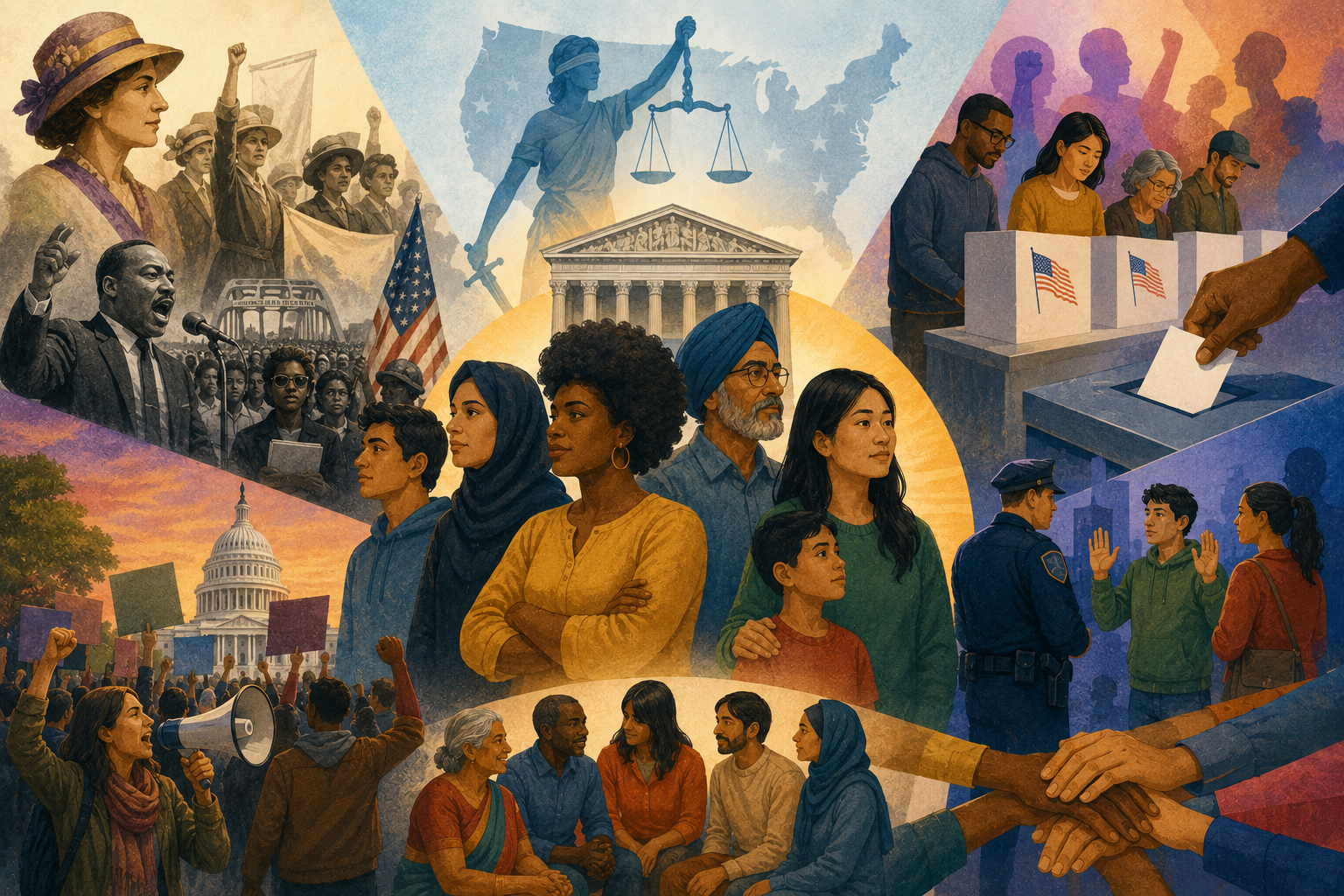
Civil rights are the legal protections that ensure people can live with dignity, participate in society, and receive equal treatment under the law. In the U.S., the Fourteenth Amendment primarily protects civil rights by guaranteeing equal protection under the law and due process for all persons. Other foundations include the Fifth Amendment’s Due Process Clause and specific voting-rights amendments, backed by federal laws like the Civil Rights Act of 1964.
Key Provisions:
Equal Protection Clause: The Fourteenth Amendment bars states from denying anyone equal treatment and fair legal rules.
Due Process Clauses: The Fifth and Fourteenth Amendments ensure the government cannot take away life, liberty, or property without fair, lawful procedures.
Voting Rights Amendments: The Fifteenth, Nineteenth, Twenty-Fourth, and Twenty-Sixth Amendments stop the government from denying the right to vote based on race, sex, or age.
A Short History of the Civil Rights Movement in the U.S.
Many of the rights Americans take for granted were won by ordinary people who were willing to organize, protest, march, petition, go to jail, and sometimes risk their lives. The women’s suffrage movement fought for generations before the Nineteenth Amendment finally guaranteed women the constitutional right to vote in 1920.
Decades later, Black Americans and their allies challenged segregation, voter suppression, discrimination, and violence. The movement helped produce landmark laws including the Civil Rights Act of 1964 and the Voting Rights Act of 1965. Black civil rights leaders in the United States and Indian independence leaders corresponded, strategized, and supported one another in their freedom struggles. They had a common enemy: white- supremacist colonialism, manifested in the United States by Jim Crow and in India by the British Raj.
Desi immigrants also owe a debt of gratitude to the Black Civil Rights movement. From Brown Girl Magazine: The Civil Rights Acts of 1957 and 1964 and The Voting Rights Act of 1965. Promising equal employment opportunities and voting rights for all Americans regardless of race, the laws allowed South Asian immigrants a path to stable employment and civic involvement.
What are our civil rights today?
The Constitution and federal civil rights laws protect a broad range of rights. Some apply to everyone in the United States; others, such as voting in federal elections, belong specifically to citizens.
Freedom of speech and expression. The First Amendment protects freedom of speech, peaceful assembly, petitioning the government, and the exercise of religion.
Equal protection and due process. The Constitution protects people from being deprived of life, liberty, or property without due process and guarantees equal protection of the laws. These protections apply to people within the United States, including noncitizens.
Freedom from discrimination. Federal civil rights laws prohibit discrimination in areas such as employment, housing, education, and public accommodations based on characteristics including race, color, national origin, religion, sex, and disability.
The right to vote. Citizens have constitutional and statutory protections against racial and other forms of discrimination in voting. The Voting Rights Act also protects voters from intimidation, threats, and coercion.
The right to participate in government. Citizens can contact elected officials, attend public meetings, petition government, organize with others, demonstrate peacefully, and seek changes to laws and policies.
Rights at work. Workers are protected against various forms of discrimination and retaliation. In addition, federal law provides specific protections against certain employment discrimination based on citizenship or immigration status and national origin for people authorized to work.
Rights when dealing with government and law enforcement. People have constitutional protections against unreasonable searches, arrests, detention, and violations of due process and equal protection. Having rights does not mean that every government action is prohibited; it means government must operate within constitutional and legal limits.
What threatens these rights?
Civil rights are rarely lost all at once. They can weaken gradually through changes in laws, government policies, court decisions, discrimination, intimidation, or simply by people becoming afraid or disengaged.
Today, concerns include voter suppression and intimidation, attempts to limit peaceful protest and expression, discrimination against racial and religious minorities, and aggressive immigration enforcement that raises questions about due process and the treatment of people in government custody. For example, current litigation over federal efforts to restrict mail voting has put voting rights and the division of federal and state election powers back before the courts.
Immigration enforcement also illustrates why knowing our rights matters. Recent reports about proposed use of electric-shock gloves by ICE officers have generated concerns about excessive force and accountability.
A functioning democracy depends on citizens paying attention before violations become irreversible.
What can a concerned citizen do?
Civil rights are not protected only by lawyers, courts, or politicians. Ordinary citizens have an important role.
Know your rights. Learn what the Constitution and laws actually guarantee rather than relying on social media or hearsay.
Vote. Elections determine who makes laws, appoints judges, runs government agencies, and oversees law enforcement.
Pay attention to local government. City councils, school boards, county governments, and other local bodies make decisions that directly affect our daily lives.
Speak up. Contact elected representatives, attend public meetings, submit public comments, and make your concerns part of the public record.
Document problems. If you experience or witness possible discrimination or a civil rights violation, keep records of what happened, when, where, and who was involved.
Report violations. The U.S. Department of Justice Civil Rights Division accepts reports of discrimination, voting rights violations, law enforcement misconduct, and other civil rights concerns. If interacting with the government feels nerve-wracking right now, find your local desi association or a friendly local representative to share your concerns with.
Stand up for other people. Civil rights become most vulnerable when we defend them only when they affect us personally. If you see someone else’s civil rights being violated, speak up…one day it could be you whose rights are being violated.